Articles
Knowledge about personal growth, biology, psychology en energy psychology
The Organizational System Audit: Evolution in the Age of AI
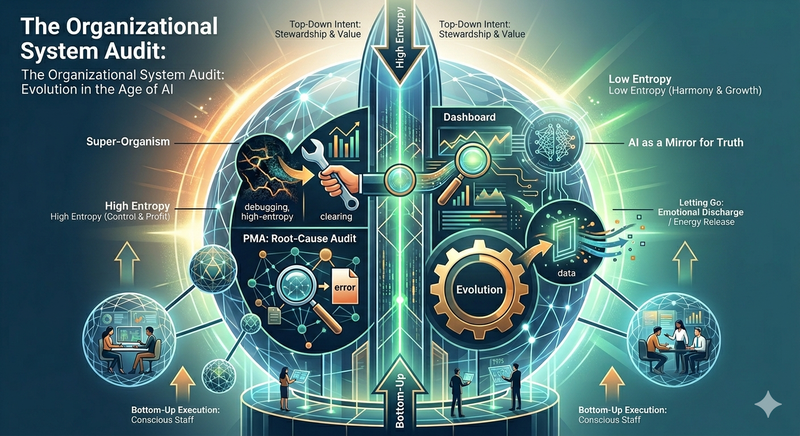
AI is no longer a future scenario; it is the reality shaking the foundations of every organization. As tasks and processes are taken over by algorithms, the question arises: what remains the role of the human? This article presents the Organizational System Audit, a blueprint for survival. We explore how Stewardship, decentralization into fractals, and a radical shift from profit to value creation are the only way forward. Learn how to use AI as a mirror for truth instead of an instrument for control, and build an organization that is truly ready for the future.
How to Avoid the 'Machine Trap' and Choose Conscious Growth
As AI taking over task execution becomes an irreversible fact, organizations are forced to make a choice: do they become soulless, purely algorithmic machines, or do they evolve into conscious, high-efficiency super-organisms? The System Audit is the process of reprogramming the organization for the future.
1. The Strategy: Top-Down Intent, Bottom-Up Execution
A System Audit only succeeds if it follows a hybrid approach.
- Top-Down (The Source Code): The "Powers That Be" must change the intent. Shift from "how do we extract maximum profit?" to "how do we lower entropy (chaos) for the whole?". Without this change at the top, any base-level effort is futile.
- Bottom-Up (The Users): Individual employees (the IUOCs) must grow in consciousness. A system is only sovereign when its people no longer react like bio-robots to the 'Carrot and Stick', but act from personal responsibility and insight.
2. Stewardship: From Owner to Guardian
The most effective form of leadership in a post-AI world is Stewardship.
- In the old model, the leader is a dictator exploiting "resources."
- In the Audit model, the leader is a steward: someone who facilitates the system so that information flows freely and entropy stays low. Stewardship means the organization is no longer a 'possession' for profit, but an 'organism' managed for the long term.
3. Architecture: Splitting into 'Fractals'
Large multinationals are often too sluggish (too high in entropy) to maintain an honest Dashboard. Information gets corrupted along the way.
- The Solution: Splitting the organization into smaller, autonomous units (cells or fractals).
- Small units have shorter feedback loops, keeping information integrity high. In a small cell, everyone is a 'User'; in a mega-corporation, everyone is just a cog.
4. AI as the Ultimate Mirror
AI is not a utopia; it is a catalyst of truth.
- AI mercilessly exposes where an organization is inefficient, corrupt, or redundant.
- If your organization thrives solely on manipulating data or controlling people, AI will take over that function.
- The System Audit uses AI not to replace humans, but to filter out the 'filler' (the boring, repetitive work), allowing human Users to focus on creativity, empathy, and complex decision-making.
Conclusion
The best results emerge from an organization that rediscovers its human scale by decentralizing (splitting up) and redefining leadership as stewardship. People must grow, not because the boss says so, but because it is the only way to remain relevant as a conscious entity in an AI-driven future.
Published 2026-04-23